
- eDelivery LT
- Peppol
Peppol is an international interoperability framework that enables businesses and public-sector organisations to exchange electronic business documents through a common set of technical specifications, business rules and governance arrangements. Instead of organisations establishing separate integrations with every trading partner, Peppol provides a standardised way to exchange information across systems, sectors and national borders.
Organisations connect to the Peppol Network through certified Peppol Service Providers. Once connected, a buyer or supplier can exchange supported electronic documents with other reachable participants without establishing a separate point-to-point connection for each business partner. The Peppol Interoperability Framework provides the governance, architecture, policies and technical specifications needed for these independently operated services to work together.
Peppol follows the four-corner model, where the sender and receiver use Access Points rather than communicating directly with each other. This approach is also fundamental to the European Commission eDelivery model: the sender's backend system communicates through one Access Point and the receiver through another, while Access Points conform to common technical specifications that make interoperability possible.
In practical terms, the four corners can be represented as:
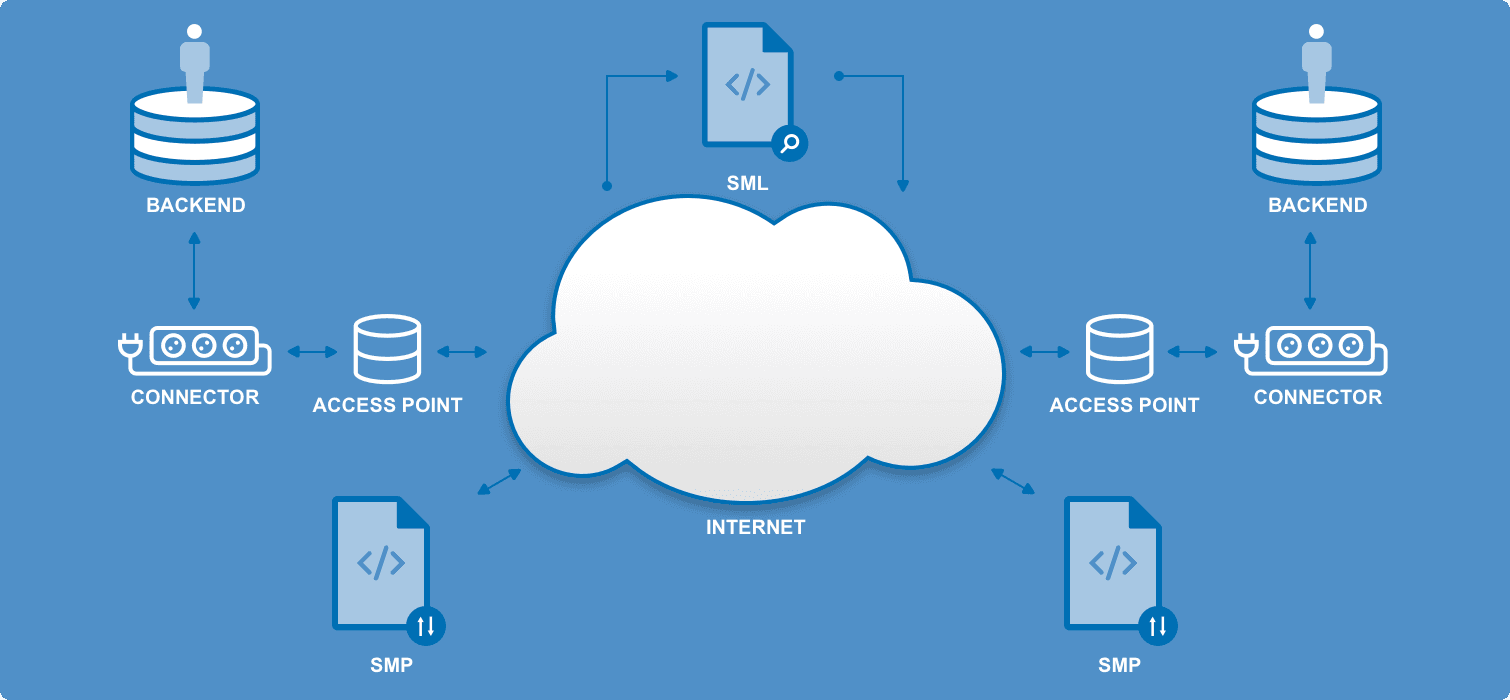
Source: European Commission, eDelivery
Peppol does not simply provide a transport network. It also standardises the structure and business rules of the documents exchanged through it. Peppol Business Interoperability Specifications, commonly referred to as Peppol BIS, define how particular business processes and document types should be represented and processed. This allows independently developed accounting, ERP, procurement and other business systems to exchange information in a predictable and interoperable form.
Peppol supports much more than electronic invoicing. Its specifications cover procurement processes before and after contract award, as well as other areas of electronic business. The currently published post-award specifications include processes and documents such as:
Peppol also provides specifications for pre-award public procurement, including processes related to procurement document access, tender submission, questions and answers, tender clarification, tender withdrawal, award notification and qualification, as well as the European Single Procurement Document (ESPD).
Interoperability in Peppol is supported by both technical and governance frameworks. OpenPeppol maintains rules covering areas such as service-provider accreditation, information security, participant identification, compliance, change management and data usage. Formal agreements establish the responsibilities of Peppol Authorities and Peppol Service Providers, creating a common operational framework for participants across different jurisdictions.
The objective of Peppol is therefore broader than electronic invoicing alone. It provides a common infrastructure and set of rules through which organisations can digitalise business processes while retaining their existing business applications and service providers. By combining standardised documents, interoperable Access Points and common governance, Peppol enables electronic trade between organisations whose IT systems may otherwise have been developed independently.
Official resources: